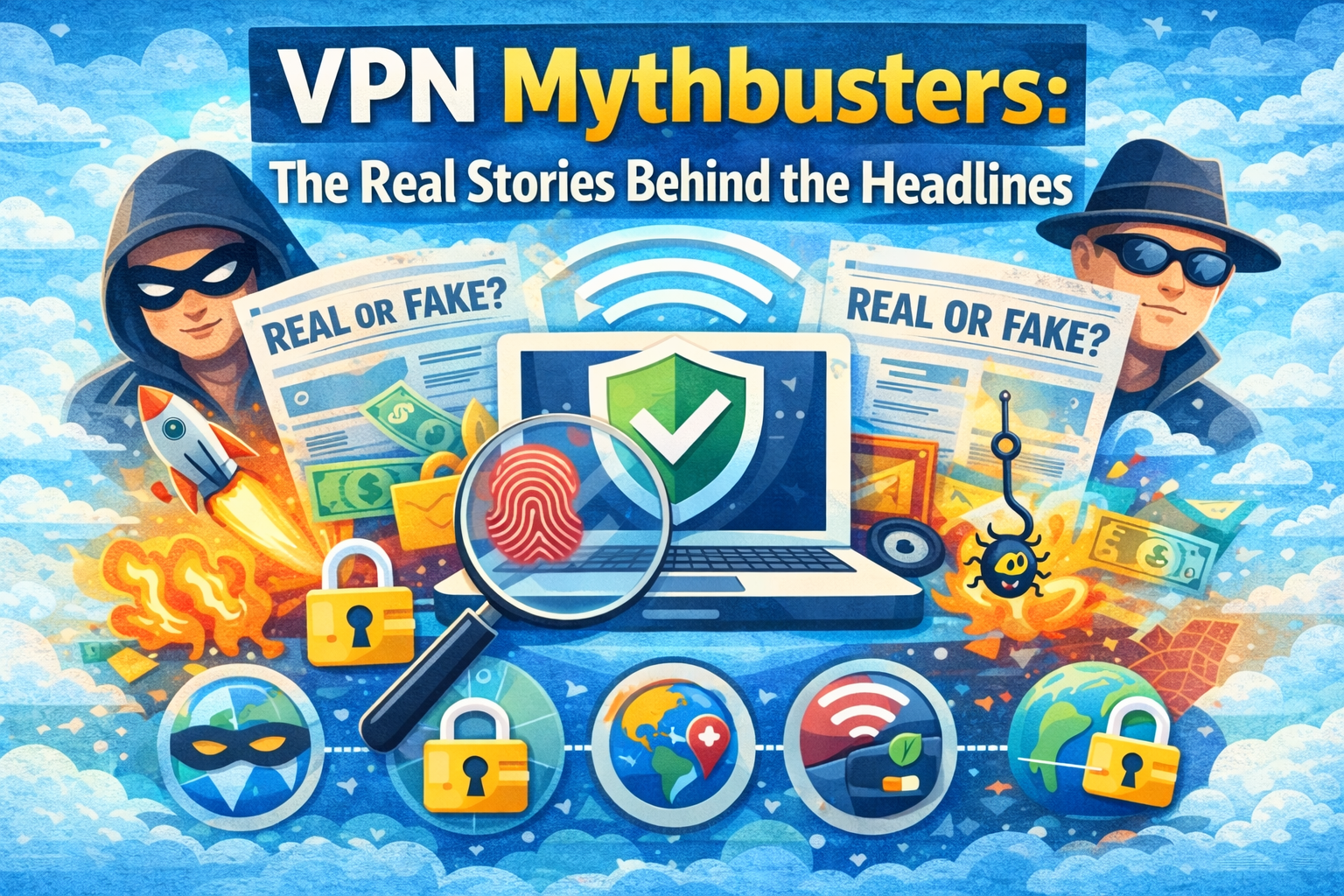
A VPN increases privacy and security, but it does not make you anonymous, malware-proof, or invincible online. Real-world cases show that VPNs are powerful tools when used correctly—and dangerous when misunderstood or chosen poorly.
What Is a VPN
A Virtual Private Network (VPN) encrypts your internet traffic and hides your IP address from websites, ISPs, and attackers on public networks. It creates a secure tunnel between your device and the VPN server.
Click here to check available vpn offers
Myth 1: “A VPN Makes You Completely Anonymous Online”
The Reality
A VPN does not guarantee total anonymity.
Your identity can still be exposed through:
- Browser fingerprinting
- Account logins (Google, Facebook, Apple ID)
- Cookies and trackers
- VPN provider logs
A VPN hides your IP — not your digital identity as a whole.
Real Case: The Cyberstalker Who Couldn’t Hide
In 2017, a cyberstalker in Massachusetts believed he was untraceable by using Tor and a VPN. Investigators later recovered a work computer containing records tied to PureVPN. Despite marketing “no-logs” messaging, timestamp and IP correlation enabled law enforcement to link the activity to his home and workplace.
Key takeaway:
If a VPN keeps any logs, anonymity can be broken through correlation.
Myth 2: “VPNs Are Only Used by Criminals”
The Reality
VPNs are legal in most countries and widely used for:
- Remote work
- Secure public Wi-Fi access
- Travel and banking
- Journalism and activism
Real-World Example: Journalists Under Censorship
Journalists in China, Iran, and similar regimes rely on VPNs to bypass censorship and protect communications with sources. Whistleblowers such as Edward Snowden used encrypted tools, including VPNs, to safely transmit sensitive material to reporters.
VPNs are tools — intent defines legality, not the technology.
Myth 3: “A VPN Will Always Slow Down Your Internet”
The Reality
A VPN can slightly reduce speed due to encryption—but in many cases it:
- Prevents ISP throttling
- Reroutes traffic away from congested paths
- Improves latency for gaming and streaming
Gamer Data Point (2024)
- 37% of gamers reported lower latency during peak hours
- 22% saw ping improvements of 20ms or more
Example:
Brazil → North America gaming
- Without VPN: ~300ms
- VPN via Miami server: ~120ms
Myth 4: “All VPNs Are the Same (Especially Free Ones)”
The Reality
VPN quality varies drastically.
Free VPNs often monetize users, not protect them.
Security Warning: Fake VPN Botnets
In 2024, Kaspersky reported a 2.5× increase in malware disguised as free VPN apps. Some popular fake apps secretly:
- Turned devices into proxy nodes
- Harvested personal data
- Sold bandwidth to criminals
One takedown uncovered 19 million hijacked IP addresses used in fraud and cyberattacks.
If you are not paying for the product, you are the product.
What a VPN Actually Does
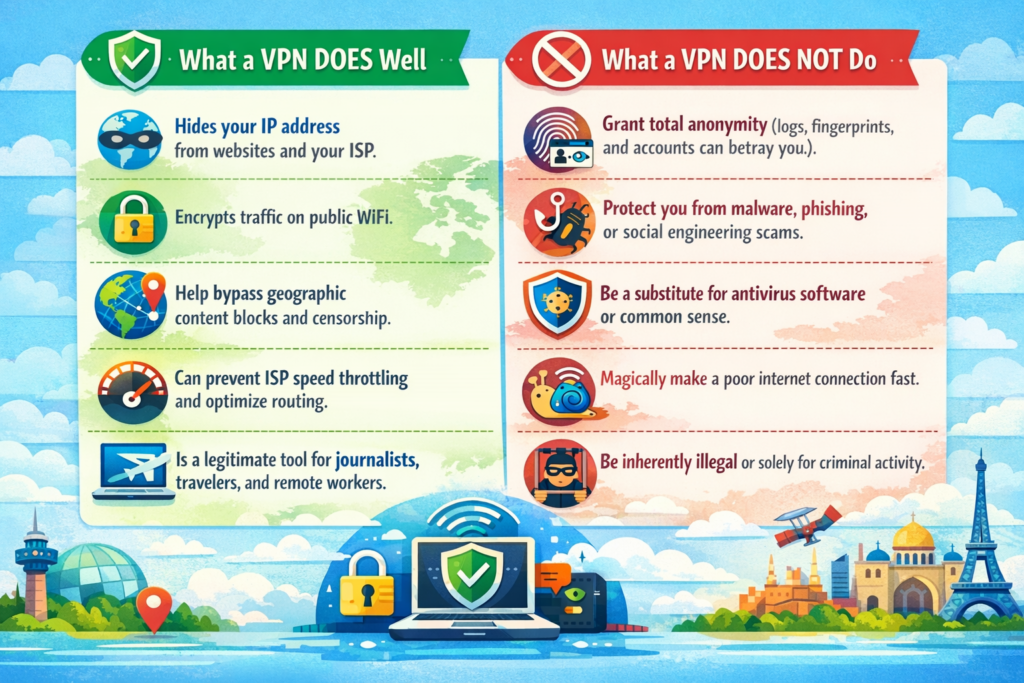
What a VPN DOES Well
What a VPN DOES NOT Do
A VPN
DOES
- Hide your IP address
- Encrypt traffic on public Wi-Fi
- Bypass geo-restrictions and censorship
- Reduce ISP throttling
- Improve routing efficiency
A VPN
DOES NOT
- Guarantee anonymity
- Protect against malware or phishing
- Replace antivirus software
- Fix bad internet connections
- Make illegal activity legal
How to Choose a VPN
When selecting a VPN, look for:
- Independent no-log audits
- Clear jurisdiction disclosure
- RAM-only servers
- Kill switch & DNS leak protection
- Transparent ownership
- No free “unlimited” plans
Frequently Asked Questions
Does a VPN hide my activity from Google?
No. If you are logged into Google, Google still knows it is you.
Can police track VPN users?
Yes, if logs exist or correlation is possible.
Are VPNs legal?
In most countries, yes. Some countries restrict or ban them.
Do VPNs stop hackers?
They protect against network-level attacks, not phishing or malware.
Is a paid VPN safer than a free VPN?
Almost always, yes.
Can VPNs improve gaming ping?
Yes, in some routing scenarios.
Final Verdict
VPNs are essential privacy tools, not magic shields. Real-world cases prove they:
- Enhance security
- Reduce tracking
- Protect data on unsafe networks
But misuse, false assumptions, or choosing unsafe providers can cause real harm.
Smart users combine VPNs with antivirus software, secure browsers, and common sense.
Need Help Choosing the Right VPN?
Contact our support team for expert guidance.
- Phone: +1-845-302-3686
- Email: [email protected]